You can finally watch our film online.
2 October 2015

Cuba signs Nagoya Protocol
We're delighted to hear that Cuba has just become the Member State number 66 of the Nagoya Protocol on Access to Genetic Resources and the Fair and Equitable Sharing of Benefits Arising from their Utilization to the Convention on Biological Diversity.
For the full list of signatories, please refer to the Convention on Biological Diversity's website.
For the full list of signatories, please refer to the Convention on Biological Diversity's website.
24 April 2013
The European Patent Office makes a step backward
Swiss organisation The Berne Declaration has recently warned that the European Patent Office was to grant more patents on plants and animals:
The Berne Declarations has also accused EPO's president Benoît Battistelli of backing the interests of agrobusiness giants Monsanto and Syngenta who "already own more than 50% of seed varieties of tomato, pepper and cauliflower registered in the EU".
We are concerned about the impacts this could have on small farming communities such as the one we filmed in South Africa.
For more information, log on to No Patents on Seeds.
In the coming weeks, around a dozen new patents will be granted, covering species such as broccoli, onions, melons, lettuce and cucumber. This is in strong contrast to EPO practise last year, when only very few patents were granted due to a pending precedent decision on the patentability of plants and animals.
The Berne Declarations has also accused EPO's president Benoît Battistelli of backing the interests of agrobusiness giants Monsanto and Syngenta who "already own more than 50% of seed varieties of tomato, pepper and cauliflower registered in the EU".
We are concerned about the impacts this could have on small farming communities such as the one we filmed in South Africa.
For more information, log on to No Patents on Seeds.
7 December 2012
The European Parliament takes a stand against biopiracy
As you may have noticed, we have been following here the
work of Catherine Grèze, a member of the european parliament of the Green
party.
Well, we have some very good news. Grèze's report on the
intellectual property rights of genetic resources in developing countries was
adopted yesterday.
After the vote, she said that
“Biopiracy is a major problem in developing countries, flying in the face of poverty reduction measures, notably for indigenous communities. This report outlines the problem and sets out measures to protect the intellectual property rights for genetic resources and traditional knowledge in poorer countries and regions. The clear support of MEPs for this report underlines the need for action.“Genetic resources are essential for sustainable agriculture and food security in developing countries, as well as for species survival and ecosystem resilience. In spite of its vital importance for human survival, genetic diversity is being lost at an alarming rate. User countries have a responsibility to tackle this and the EU must play an active role.
The recently-concluded Nagoya Protocol under the Convention on Biological Diversity (CBD) sets out key provisions for addressing biopiracy, notably on access and benefit-sharing, prior informed consent and mutually-agreed terms. The EU must ratify the protocol as swiftly as possible and take immediate steps to ensure it is effective, such as through binding measures on compliance. However, more needs to be done to strengthen the rights of farmers in developing countries, as well to strengthen the rights of indigenous and local communities.
Ultimately, there is also a need to address the lack of coherence in the global governance system for dealing with the intellectual property implications of genetic resources. International IP arrangements, notably the WTO’s TRIPS agreement, must be reformed to ensure they support the overarching goals of the CBD on genetic resources, rather working against them. One important step would be the inclusion of a binding regulation under TRIPS requiring patent applicants to disclose the origin of any genetic resources and traditional knowledge used in invention.”To view the report please click here and scroll down to the bottom of the page.
Beware of AGRA?
One of the organisation featured in the documentary, The
Africa Centre for Biosafety (ACB), is sending warnings against The Alliance for
a Green Revolution in Africa (known as AGRA and supported by agribusiness
multinationals and the Gates Foundation).
Now quoting both a study published by ACB and this
article published on All Africa
According to ACB, "AGRA effectively seeks to institutionalise biopiracy by accessing publicly available genetic resources, patenting or imposing other intellectual property rights on the resulting seeds, and then using these industrial monoculture crops to channel African farmers into focusing on earning enough export cash to buy the privatised seed," adding, "The AGRA model uses free inputs to develop monopoly control over outputs and expects farmers to pay for seeds they previously shared and traded, and played a major part in developing over thousands of years."
One of the stands we are taking in our documentary is
against the patenting of traditional knowledge and genetic resources following
the system in place.
10 September 2012
Now is the time
The last few weeks have seen a richer media coverage of the biopiracy problem.
But countries like the United States or Great-Britain - usually well-known for advocacy and human rights defence - are still surprisingly slow at picking up the trend.
As we are getting closer to the opening of the COP11 to be held in Hyderabad this coming October, we hope journalists and politicians such as MEP Catherine Grèze will be getting increased attention on the global debate around the use of genetic resources.
Grèze's commitment was shown last week when she co-organised with other Green MEPs the "Greens conference"entitled "Financing and biopiracy: the challenges of the next UN Biodiversity Summit (COP11, India)".
But countries like the United States or Great-Britain - usually well-known for advocacy and human rights defence - are still surprisingly slow at picking up the trend.
As we are getting closer to the opening of the COP11 to be held in Hyderabad this coming October, we hope journalists and politicians such as MEP Catherine Grèze will be getting increased attention on the global debate around the use of genetic resources.
Grèze's commitment was shown last week when she co-organised with other Green MEPs the "Greens conference"entitled "Financing and biopiracy: the challenges of the next UN Biodiversity Summit (COP11, India)".
5 February 2012
Panama, first country to benefit from Nagoya fund
We are delighted to read on Sci-Dev website that
"The Nagoya Protocol Implementation Fund (NPIF) — has announced its first beneficiary: a project exploring Panama's natural resources for use in the pharmaceutical and agrochemical industries."
How easy would it be to set up a new way of cultivating and trading umckaloabo (pelargonium), making sure it follows the principles stressed by the Nagoya protocol? Let us know what you think.
"The Nagoya Protocol Implementation Fund (NPIF) — has announced its first beneficiary: a project exploring Panama's natural resources for use in the pharmaceutical and agrochemical industries."
How easy would it be to set up a new way of cultivating and trading umckaloabo (pelargonium), making sure it follows the principles stressed by the Nagoya protocol? Let us know what you think.
28 January 2012
Al Jazeera's "The Stream" on Biopiracy
Watch the last edition of "The Stream" on a famous (alleged) case of biopiracy involving agro-giant Monsanto.
Where does the European Union stand in the fight against biopiracy?
Biopiracy was recently discussed at the EU parliament. I don't think this happens everyday so it is worth pointing it out...
MEP of the south-west of france group of the Greens, Catherine Grèze, commented on a study commissioned by the Development Committee. For her, it "reveals or emphasizes the need for a comprehensive approach with regard to the impact of intellectual property rights in developing countries".
She said the two main sectors involved are agriculture and health and that biopiracy has generally two main causes: "lack of regulation in developing countries and / or lack of compliance mechanisms in developed countries. Responsibilities are finally divided - on one hand, developing countries should establish an adequate legal framework for access and benefit-sharing, on the other, developed countries must provide effective mechanisms to ensure sharing fair and equitable benefit from the use of genetic resources."
There are 3 main challenges that the EU should be dealing with:
- make sure that the Nagoya Protocol is ratified.
- reforming the system of intellectual property
- protection of traditional knowledge and recognition of indigenous rights at a EU level
Grèze stressed that "the temptation will be for the EU to hide behind the World Trade Organisation when it could be the driving force and reveal the concerns of poor countries to the rest of the world".
Read Catherine Grèze's itnervention in French here.
MEP of the south-west of france group of the Greens, Catherine Grèze, commented on a study commissioned by the Development Committee. For her, it "reveals or emphasizes the need for a comprehensive approach with regard to the impact of intellectual property rights in developing countries".
She said the two main sectors involved are agriculture and health and that biopiracy has generally two main causes: "lack of regulation in developing countries and / or lack of compliance mechanisms in developed countries. Responsibilities are finally divided - on one hand, developing countries should establish an adequate legal framework for access and benefit-sharing, on the other, developed countries must provide effective mechanisms to ensure sharing fair and equitable benefit from the use of genetic resources."
There are 3 main challenges that the EU should be dealing with:
- make sure that the Nagoya Protocol is ratified.
- reforming the system of intellectual property
- protection of traditional knowledge and recognition of indigenous rights at a EU level
Grèze stressed that "the temptation will be for the EU to hide behind the World Trade Organisation when it could be the driving force and reveal the concerns of poor countries to the rest of the world".
Read Catherine Grèze's itnervention in French here.
25 January 2012
Biopiracy and the Nagoya Protocol

Source: CIAT International Center for Tropical Agriculture, on Flickr
Since we started working on Pelargonium we have fully acknowledged how important it is to strengthen the legal framework on biodiversity-related issues, and particularly trading resources.
The film shows a medicinal plant sought after by too many predators and needing protection.
The Convention on Biological Diversity (CBD) established in Rio in 1992 is aiming at protecting the access to biological resources and the fair and equitable sharing of benefits derived from their collection. But 'biopiracy' has yet to be properly addressed by the convention, and the Nagoya Protocol could be a significant step in establishing guidelines for access and benefit sharing.
As pointed out by Appleyard Lees, a UK-based firm of Patent and Trade Marks attorneys, "signature has no legal effect, as such, but it is a commitment to bring
the provisions into national law and to ratify the Protocol" and "it is anticipated that the protocol will enter into force before the
eleventh meeting of the Conference of the Parties to the Convention on
Biological Diversity, Hyderabad in October 2012."
The Nagoya Protocol is open to signature until February 1st.
Visit the CBD website for more information.
11 January 2012
Web campaign

"Pelargonium" launched its web campaign last weekend on facebook and twitter.
People often wonder if these social media campaigns work. We had a few doubts ourselves. But creating a buzz does help.
We are reaching out to all our friends, and most importantly to NGOs and other organisations involved in biodiversity protection and defending other green causes.
We are also looking to connect with journalists.
Little by little, we are generating a genuine interest in our Pelargonium and raising awareness on an issue that has not received much coverage yet - biopiracy . But we do need your help in getting our voice heard. So what can YOU do?
>> Please, like our facebook page. Even better, it with your friends on your walls.
>> If you have a twitter account, please follow @PelargoniumDoc to get updates from us, and retweet them.
>> Keep coming back to our blog and share your thoughts with us in the comment box.
>> We also love to hear from our "fans" on the old email pelargoniumproject(at)gmail(dot)com
We have been hugely relying on our friends and families since the adventure started nearly two years ago, and the Internet has been a fantastic tool to get this film made.
Thank you to all those who have been helping, and all those who will be.
27 December 2011
Pelargonium screening at Paris Environment Festival (Feb 2012)
Pelargonium will be showing at Paris' International Festival du Film d'Environnement on February 10th and 14th. We will post the exact times and locations shortly.
Filmmakers Georgina André and Victoria Baux will be attending the Q&A cessions following the screening on the 10th.
Filmmakers Georgina André and Victoria Baux will be attending the Q&A cessions following the screening on the 10th.
30 July 2011

10 January 2011
Calling all London supporters
Our film is now finished and we are looking to meet with London-based advisory groups, NGOs and think-tanks working on biodiversity-related issues.
If you live in London and would like to screen our film, please get in touch for more info.
If you live in London and would like to screen our film, please get in touch for more info.
8 January 2011
Documentary-making 3.0
Independent filmmakers rely increasingly on a variety of web tools to make and promote their documentaries. With The Pelargonium Project, we also tried crowd-funding.
Websites like Indiegogo and Kickstarter are funding platforms where artists, journalists, organisations etc post a presentation of their project (this includes a text usually, pictures, sometimes a trailer), and invite their friends to donate. Sometimes, project founders get the totality of their budget covered. With our Indiegogo page, in a month we managed to cover about 15% of our expenses, which is about 4% of our total budget.
Another example is The Last Prince of the Kalash, a documentary about a game of hokey played by a Pakistani group, the Kalash, whose survival is being threatened by the recent floods. This unique sport has never been filmed or photographed. The filming crew is currently getting ready for this shoot, and actively looking for funds online. You can donate here.


Websites like Indiegogo and Kickstarter are funding platforms where artists, journalists, organisations etc post a presentation of their project (this includes a text usually, pictures, sometimes a trailer), and invite their friends to donate. Sometimes, project founders get the totality of their budget covered. With our Indiegogo page, in a month we managed to cover about 15% of our expenses, which is about 4% of our total budget.
Another example is The Last Prince of the Kalash, a documentary about a game of hokey played by a Pakistani group, the Kalash, whose survival is being threatened by the recent floods. This unique sport has never been filmed or photographed. The filming crew is currently getting ready for this shoot, and actively looking for funds online. You can donate here.

Film Finished!
Carte Blanche is set to air a 10-minute version of Pelargonium Project: Trading Traditional Knowledge in South Africa at the end of next week. Meanwhile in London we will be finishing off the online edit of our 29-minute version tomorrow. The sound mix has been signed off tonight and we only need to do a bit of color correction.
We are looking forward to showing the film to all those who have contributed and get their feedback, and also share it with as many people as possible.
If you work for/with an organisation or a festival interested in film and biodiversity-related issues, do not hesitate to contact us at pelargoniumproject [a] gmail.com
This project is also educational and we would be very interested in including our film in discussions and debates about the trade of traditional knowledge and genetic resources and/or the implementation of new regulations aimed at protecting biodiversity.
Soon we will be posting more information on where you can view the film.
We are looking forward to showing the film to all those who have contributed and get their feedback, and also share it with as many people as possible.
If you work for/with an organisation or a festival interested in film and biodiversity-related issues, do not hesitate to contact us at pelargoniumproject [a] gmail.com
This project is also educational and we would be very interested in including our film in discussions and debates about the trade of traditional knowledge and genetic resources and/or the implementation of new regulations aimed at protecting biodiversity.
Soon we will be posting more information on where you can view the film.
7 December 2010
Carte Blanche
To our South African audience, please stay tuned as our film will air on 'Carte Blanche' in the next few weeks.
Carte Blanche is an investigative Programme and you can view some of their films here: http://beta.mnet.co.za/carteblanche/?ShowId=1
Carte Blanche is an investigative Programme and you can view some of their films here: http://beta.mnet.co.za/carteblanche/?ShowId=1
7 October 2010
Shooting in South Africa
Shooting this documentary was one of the most exciting parts of the adventure. It included the discovery of South Africa, a road trip with the unavoidable "slight problems" and some unforgettable encounters.
In total, we spent three weeks in South Africa - driving from Johannesburg, to Pretoria then down to the Eastern Cape, one of the most underdeveloped regions in the country with a 29% unemployment rate in 2009.
 Source: www.places.co.za
Our first stop there was East London. We finally met up with Vukile Pokwana, a local journalist who had been helping us setting up the shoot whilst we were still in Europe. A busy man - he is very involved in the cultural life of the Eastern Cape - Vukile also has a lot of experience fixing for international broadcasters, including Sky and the BBC.
We drove with our new guide further north, first to King William's Town to arrange an interview with local government officials and then to Alice (near Fort Beaufort on the map), a small town near where our story was unfolding. This is where we met local harvesters, community spokespeople, middlemen and the German company's supplier.
After 3 days in the pampa, we headed south to Grahamstown, another town famous for its university. We visited its herbarium and met the academic who alerted the African Centre for Biosafety that pelargonium was being heavily harvested.
On our arrival in Johannesburg at the end of our trip, we were greeted by football supporters from all over the world. A perfect ending.
In total, we spent three weeks in South Africa - driving from Johannesburg, to Pretoria then down to the Eastern Cape, one of the most underdeveloped regions in the country with a 29% unemployment rate in 2009.
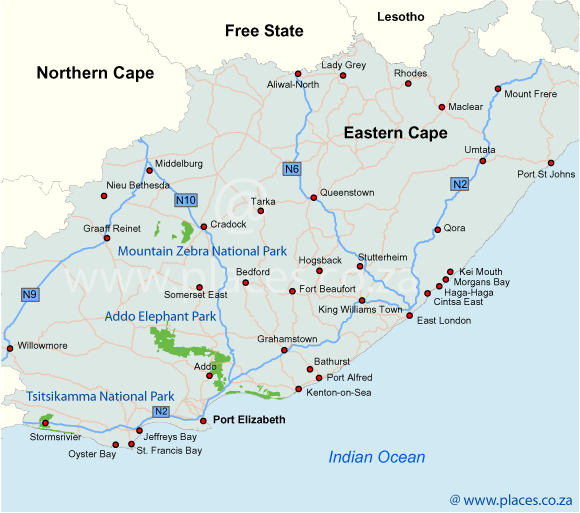 Source: www.places.co.za
We drove with our new guide further north, first to King William's Town to arrange an interview with local government officials and then to Alice (near Fort Beaufort on the map), a small town near where our story was unfolding. This is where we met local harvesters, community spokespeople, middlemen and the German company's supplier.
After 3 days in the pampa, we headed south to Grahamstown, another town famous for its university. We visited its herbarium and met the academic who alerted the African Centre for Biosafety that pelargonium was being heavily harvested.
On our arrival in Johannesburg at the end of our trip, we were greeted by football supporters from all over the world. A perfect ending.
5 October 2010
The Edit

The edit is going well. We had a very productive editing cession with Jamie Riordan from Propeller Media yesterday. Jamie produced, directed and edited documentaries for Al Jazeera English, CNN, and Sky amongst others. He is now directing trailers in Qatar for Doha Film Institute.
Georgina and I came back from our shoot in South Africa and Germany with fantastic content. We managed to interview pretty much everyone we were after from NGO representatives, to the drug company's spokespeople, government officials and, of course, community members and pelargonium harvesters. We had to cut 22 hours of footage down to 26 minutes.
What we found most challenging in this edit was to give a clear analysis of the challenges faced by pharmaceutical companies prospecting plants in countries like South Africa, and also question the idea of "fair trade" looking at where it could be failing, through the story of the pelargonium plant.
There is only one way to find out if you think we succeeded in our mission and we hope you get to view the documentary soon wherever you are in the world.
Subscribe to:
Posts (Atom)