30 July 2011

Poster & Press Kit (French)

Designed by Jennifer André

Email us to request French press kit.

10 January 2011

Biopolitical: Biopiracy and the Convention on Biological Diversity

Biopolitical: Biopiracy and the Convention on Biological Diversity: "Marcelino Fuentes"

Calling all London supporters

Our film is now finished and we are looking to meet with London-based advisory groups, NGOs and think-tanks working on biodiversity-related issues.

If you live in London and would like to screen our film, please get in touch for more info.

8 January 2011

Documentary-making 3.0

Independent filmmakers rely increasingly on a variety of web tools to make and promote their documentaries. With The Pelargonium Project, we also tried crowd-funding.

Websites like Indiegogo and Kickstarter are funding platforms where artists, journalists, organisations etc post a presentation of their project (this includes a text usually, pictures, sometimes a trailer), and invite their friends to donate. Sometimes, project founders get the totality of their budget covered. With our Indiegogo page, in a month we managed to cover about 15% of our expenses, which is about 4% of our total budget.

Another example is The Last Prince of the Kalash, a documentary about a game of hokey played by a Pakistani group, the Kalash, whose survival is being threatened by the recent floods. This unique sport has never been filmed or photographed. The filming crew is currently getting ready for this shoot, and actively looking for funds online. You can donate here.


Film Finished!

Carte Blanche is set to air a 10-minute version of Pelargonium Project: Trading Traditional Knowledge in South Africa at the end of next week. Meanwhile in London we will be finishing off the online edit of our 29-minute version tomorrow. The sound mix has been signed off tonight and we only need to do a bit of color correction.

We are looking forward to showing the film to all those who have contributed and get their feedback, and also share it with as many people as possible.

If you work for/with an organisation or a festival interested in film and biodiversity-related issues, do not hesitate to contact us at pelargoniumproject [a] gmail.com

This project is also educational and we would be very interested in including our film in discussions and debates about the trade of traditional knowledge and genetic resources and/or the implementation of new regulations aimed at protecting biodiversity.

Soon we will be posting more information on where you can view the film.

7 December 2010

Carte Blanche

To our South African audience, please stay tuned as our film will air on 'Carte Blanche' in the next few weeks.

Carte Blanche is an investigative Programme and you can view some of their films here: http://beta.mnet.co.za/carteblanche/?ShowId=1

7 October 2010

Shooting in South Africa

Shooting this documentary was one of the most exciting parts of the adventure. It included the discovery of South Africa, a road trip with the unavoidable "slight problems" and some unforgettable encounters.

In total, we spent three weeks in South Africa - driving from Johannesburg, to Pretoria then down to the Eastern Cape, one of the most underdeveloped regions in the country with a 29% unemployment rate in 2009.
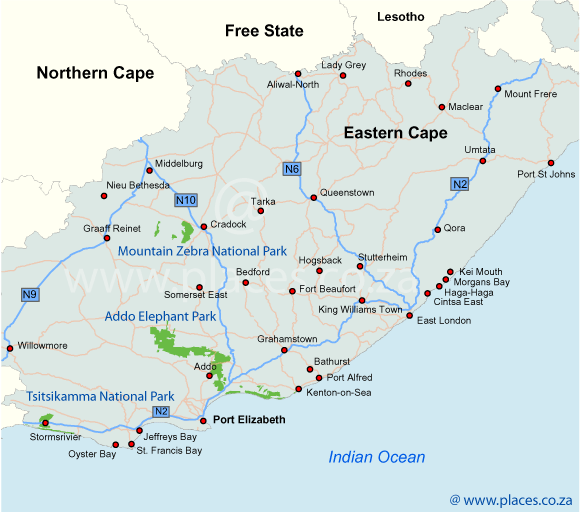
Source: www.places.co.za

Our first stop there was East London. We finally met up with Vukile Pokwana, a local journalist who had been helping us setting up the shoot whilst we were still in Europe. A busy man - he is very involved in the cultural life of the Eastern Cape - Vukile also has a lot of experience fixing for international broadcasters, including Sky and the BBC.

We drove with our new guide further north, first to King William's Town to arrange an interview with local government officials and then to Alice (near Fort Beaufort on the map), a small town near where our story was unfolding. This is where we met local harvesters, community spokespeople, middlemen and the German company's supplier.

After 3 days in the pampa, we headed south to Grahamstown, another town famous for its university. We visited its herbarium and met the academic who alerted the African Centre for Biosafety that pelargonium was being heavily harvested.

On our arrival in Johannesburg at the end of our trip, we were greeted by football supporters from all over the world. A perfect ending.